ENGINEERING CASE STUDY
ULTEM 9085 Additive Manufacturing Optimization
A structured experimental approach to thin-wall polymer manufacturing, with approximately 80% less support material and 23% less print time reported for the project.
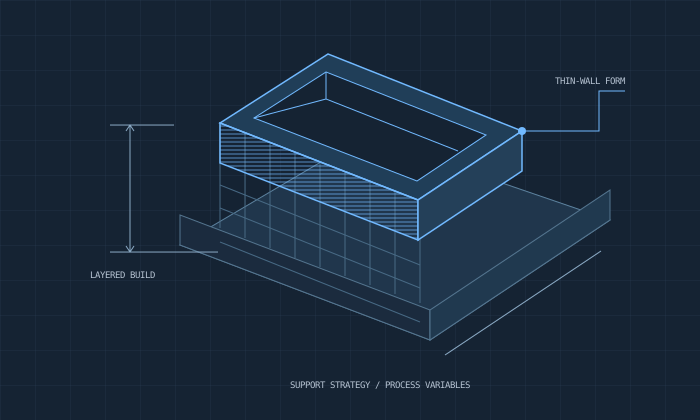
Engineering challenge
Evaluate ULTEM 9085 thin-wall performance while reducing the support material and print time required by the additive manufacturing process.
Constraints
The project concerned thin-wall polymer fabrication on a Fortus 450mc. Changes in manufacturing strategy were evaluated alongside mechanical testing and microCT review. Specific wall dimensions, parameter levels, and performance acceptance criteria are not included in the available public source material.
My contribution
My résumé records the use of a Taguchi L27 design of experiments, Fortus 450mc fabrication, mechanical testing, and microCT review in this senior design project. The reported reductions are project outcomes, not a claim of sole ownership of the team’s work.
Methods & tools
- Taguchi L27 design of experiments (DOE).
- ULTEM 9085 fabrication on a Fortus 450mc using fused deposition modeling (FDM).
- Mechanical testing and microCT review to evaluate thin-wall performance.
Verification
Mechanical testing and microCT review were part of the evaluation. The existing portfolio and résumé report the support-material and print-time reductions, but do not provide the comparison baseline, raw data, uncertainty, or acceptance thresholds. These figures are therefore presented as approximate reported project results, not independently audited performance claims.
Engineering outcomes
The project reported an approximately 80% reduction in support material and an approximately 23% reduction in print time while evaluating thin-wall performance. These reductions belong to the same senior design project; they are separate from the later coupon-characterization and depot-tooling work.
Lessons & applications
This work brings together experimental design, fabrication, and verification. Its transferable application is an engineering approach that considers process efficiency and material performance together. No claim of flight qualification or universal applicability is made.
Related skills
SOURCE & SCOPE
Based on the existing published portfolio and supplied résumé. This page is a public, high-level summary; it does not include raw test data, proprietary technical documents, or program-specific requirements.
Explore related work
NEXT CHAPTER
Let's engineer
what's next.
Discuss engineering opportunities, explore related work, or take a closer look at my professional background.