ENGINEERING CASE STUDY
Manufacturing Tooling & Depot Process Improvement
Practical additive-manufactured tooling and sustainment support at Fleet Readiness Center Southwest, connecting shop needs to manufacturable solutions.
Engineering challenge
Support depot manufacturing needs through tooling development, additive manufacturing request management, and practical alternatives to purchased or temporarily unavailable shop items.
Constraints
The work involved manufacturing feasibility, material and delivery estimates, fit-check coordination, and labor/material/print-time tracking. Commercial blast-shop conveyor buckets were temporarily unavailable. Tool-tracing savings were projected for a portion of the shop floor, not the entire depot.
My contribution
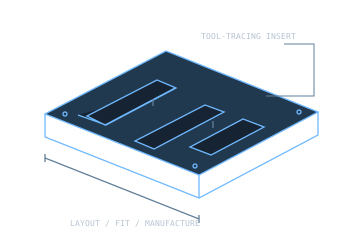
I designed, scanned, printed, and installed tool-tracing inserts. I also developed nylon masking plugs for an E-2D launch bar and supported production of 50 blast-shop conveyor buckets. These were distinct efforts during the same rotation; the projected savings figure applies specifically to the tool-tracing initiative.
Methods & tools
- Design, scanning, additive manufacturing, and installation of tool-tracing inserts.
- AM Portal request management from intake through closeout: feasibility, estimates, design uploads, fit checks, and tracking.
- Nylon masking-plug development and testing.
- Manufacturing cost comparison for additively manufactured conveyor buckets.
Verification
The résumé records installation of the tool-tracing inserts and successful testing of the nylon masking plugs. It attributes the approximately $140,000 savings projection to a Manufacturing Branch Head, compared with purchased and laser-cut foam methods. The detailed cost-model assumptions, labor allocation, and realized financial results are not provided.
Engineering outcomes
Tool tracing: approximately $140,000 in savings projected by a Manufacturing Branch Head for a portion of the shop floor; not reported as realized savings.
Masking plugs: successful testing released work delayed about two weeks, followed by production of 50 plugs in approximately 36 hours.
Conveyor buckets: supported production of 50 buckets for approximately $177 in AM material, compared with more than $825 before shipping and taxes for commercial replacements. This compares material cost with purchase price and is not a complete lifecycle-cost calculation.
Additional sustainment work: designed and tested a two-piece nylon arresting-hook shank mold; reviewed LM2500 engineering requests, measurement reports, physical components, technical-manual limits, repair options, inventory, and Bill of Materials data.
Lessons & applications
This rotation connected design and manufacturing decisions to fit, delivery, configuration control, cost, and readiness. The financial lesson is equally important: distinguish projected savings, material-only costs, and full realized costs when communicating engineering impact.
Related skills
SOURCE & SCOPE
Based on the existing published portfolio and supplied résumé. This page is a public, high-level summary; it does not include raw test data, proprietary technical documents, or program-specific requirements.
Explore related work
NEXT CHAPTER
Let's engineer
what's next.
Discuss engineering opportunities, explore related work, or take a closer look at my professional background.